
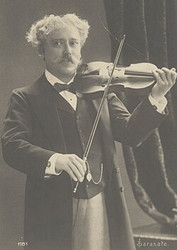
Written For Him, Written By Him: Pablo de Sarasate's Concert Showpieces
Posted by Paul Wood on 5th May 2026
Three composers, three masterpieces, one violinist.
Édouard Lalo wrote the Symphonie espagnole for him. Saint-Saëns wrote the Introduction and Rondo Capriccioso for him. Bruch wrote the Scottish Fantasy for him. The violinist who inspired all three was Pablo de Sarasate, a Spaniard from Pamplona who dominated the concert stages of Europe for four decades and was, by any measure, the most sought-after soloist of his generation.
Those works are all still played. But so are the pieces Sarasate wrote for himself, and in some concert halls, rather more often.
Sarasate was born in Pamplona in 1844, the son of a military bandmaster. He studied at the Paris Conservatoire, where he graduated with the premier prix at thirteen, which gave his classmates something to think about. He spent the rest of his career in almost constant concert activity across Europe and the Americas. He was not a composer in the traditional sense. No symphonies, no chamber music, no operas. But he had a specific and invaluable gift: he understood the violin completely, and he knew exactly what worked in a concert hall.
Everything he wrote is idiomatic in the deepest sense. The difficulties are real, but they work with the violin rather than against it, and every passage feels as though it grew directly out of the instrument's own character. That's rarer than it sounds.
Zigeunerweisen, Op. 20
The most famous of all Sarasate's works opens with an orchestral introduction of real drama, the strings cutting in with a phrase of almost violent energy, before the violin enters with the sombre, plangent main theme that everyone knows. Its slow middle section is the heart of the piece: long, searching phrases over a simple accompaniment, the violin at its most nakedly expressive. Then the finale, Un poco più vivo moving into Allegro molto vivace, is a sustained technical assault of left-hand pizzicato, rapid spiccato, harmonics and double stops. What makes it deceptive is that it sounds glamorous. The physical demands are relentless.
Carmen Concert Fantasy, Op. 25
Sarasate wrote this in 1883, eight years after Bizet's death and eight years after Carmen's troubled premiere. He chose five themes from the opera: the Aragonaise, the Habanera, a fragment from the act 1 confrontation, the Seguidilla, the Gypsy Song. He arranged them into a sequence that moves from brilliance to intimacy and back again. The Habanera movement is the one most people know, but the slow central section, built from Carmen's mocking song to the officer Zuniga, is where the piece shows its real character. Sarasate understood what each theme could do on a violin and built accordingly.
Navarra, Op. 33
The only work here written for two soloists, Navarra takes its name from Sarasate's home region, the old kingdom of Navarra, of which Pamplona is the capital. It's built on the jota, a vigorous traditional dance, and the two violin parts are equal in every sense. This is a duet, not a concerto with an afterthought. For conductors and teachers, that makes it an unusual and attractive proposition: a substantial concert work that gives two players equal standing, with the full string orchestra behind them. It sits differently in a programme from the solo showpieces, and it's none the worse for that.
Introduction and Tarantella, Op. 43
Written in 1899, this is Sarasate at his most accessible without being any less demanding. The Introduction is lyrical and unhurried, the violin singing over a simple accompaniment with real warmth. Then the Tarantella arrives, an Italian dance form that Sarasate treats with the same fluency and lightness that runs through everything he wrote. Where Zigeunerweisen has brooding weight, the Introduction and Tarantella is fleet-footed and elegant. Both qualities are entirely his own.
Saint-Saëns: Introduction and Rondo Capriccioso, Op. 28
Saint-Saëns wrote this for Sarasate in 1863, when the violinist was nineteen years old. Sarasate premiered it in Paris, and the two men maintained a close professional friendship for the rest of their careers. Saint-Saëns dedicated his Third Violin Concerto to him as well. The Introduction and Rondo Capriccioso is Spanish in character, which was no accident. Saint-Saëns shaped it for a Spanish violinist, with a harmonic language and rhythmic vitality that Sarasate could make entirely his own. It has never left the repertoire.
The MyMusicScores arrangements
Every one of these works exists in two standard forms: a violin and piano reduction, and the full orchestral score with parts. Both have their place, but there's a gap between them that working musicians encounter regularly.
A full symphony orchestra is many things. Readily available at short notice is rarely one of them. A young soloist being featured at a school or county concert, a professional violinist performing with a community string orchestra, a youth ensemble wanting to give their principal player a moment in the spotlight: all of these call for something between the piano reduction and the full orchestral score. These arrangements are that middle ground. The soloist gets the full weight and colour of a string orchestra behind them, without the logistical demands of a complete symphonic complement. Each one is written specifically for strings, professionally engraved, and ready to perform.
All five are available as instant PDF downloads with no performance licence required and permission to record included.
- Sarasate — Zigeunerweisen Op. 20 for Violin and String Orchestra
- Sarasate — Carmen Concert Fantasy Op. 25 for Violin and String Orchestra
- Sarasate — Navarra Op. 33 for Two Violins and String Orchestra
- Sarasate — Introduction and Tarantella for Violin and String Orchestra
- Saint-Saëns — Introduction and Rondo Capriccioso Op. 28 for Violin and String Orchestra
Browse the complete Sarasate collection at MyMusicScores.com