
Bruch and his Violin: Concerto No. 1 in G minor
Posted by Paul Wood on 3rd Jun 2026
Most people know the Bruch Violin Concerto in G minor. Fewer know that the version they play is not quite the one Bruch wrote.
By the time Joseph Joachim had finished with it, he had reworked the virtuosic passages, altered the structure, changed the title from "Fantasy" to "Concerto," and revised the dedication, crossing out the word "respect" and substituting "friendship." The concerto that went on to become one of the most played works in the violin repertoire was, in a meaningful sense, a collaboration. Bruch received the credit. Joachim received the dedication, amended in his own hand.
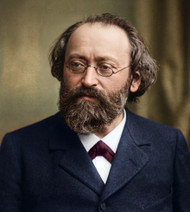
Max Bruch (Cologne, 6 January 1838 – Berlin, 2 October 1920) showed his abilities early enough to attract serious attention: his first musical education came from his mother (a singer), and he was composing from childhood. At fourteen he won the Frankfurt Mozart-Stiftung Prize, which enabled further study (including with Ferdinand Hiller), and by his thirties he had established himself as one of Germany's most respected composers, particularly among choral societies who could not get enough of his large-scale vocal works. He wrote operas, symphonies, chamber music, and oratorios. The catalogue is substantial. Today, most of it is unplayed.
The sketches for the G minor concerto began in 1857, but Bruch took his time. He was cautious about placing his name alongside Mendelssohn's in the small company of composers who had written great German violin concertos. The first version was premiered in Koblenz in 1866 with Otto von Königslow as soloist. It went well enough, but Bruch felt the work could be improved.
Joachim agreed to help. The collaboration that followed was thorough: Joachim annotated the score, reworked passages designed to show off the instrument's capabilities, pushed for structural adjustments, and eventually persuaded Bruch to drop the title "Fantasy" in favour of "Concerto." Their letters make it clear this was not Joachim rubber-stamping a finished work. He was shaping it. The definitive version premiered in Bremen in 1868, with Joachim as soloist. His verdict was that the work was "the richest, most seductive" of the four great German violin concertos, alongside Beethoven, Mendelssohn, and Brahms. He was not wrong.
The three movements
The concerto opens not with a classical first movement but with a Vorspiel, a prelude marked Allegro moderato, in G minor. It is short and searching, and runs without a break into the Adagio, which is the emotional heart of the work. In E flat major, the Adagio gives the soloist a melody of sustained lyrical beauty. The finale, Allegro energico in G major, has the energy and folk-inflected character of a dance and brings the concerto to a decisive close. The deliberate blurring of the boundary between the first and second movements is one of the concerto's most distinctive features. They are designed to be heard as a single continuous arc.
The lost manuscript and the small matter of rights
Bruch's feelings about the concerto's success were complicated. He was proud of it, and fierce in its defence. He once suggested that any critic who dismissed it could go drown himself, which is one way to respond to a review. But as the work became ubiquitous, his frustration grew. Violinists played it to the exclusion of his other concertos, his Scottish Fantasy, his chamber music, his symphonies. "Did I perhaps write just this one?!" he complained to his publisher.
He had also sold the rights early for a modest sum, which meant the concerto's success brought him little. In his later years, facing financial difficulty, he entrusted the original manuscript to two pianists to sell in America. It disappeared. It eventually surfaced in the New York Public Library, where it remains.
The MyMusicScores arrangements
Both arrangements are for violin and string orchestra, and both address a practical gap that violin and piano editions and full orchestral recordings cannot fill.
The full concerto arrangement covers all three movements. For a young soloist performing with a school or youth orchestra, or a professional violinist working with a community ensemble, it makes the complete work genuinely practical without requiring wind or brass players.
The first movement arrangement solves a more specific problem. Because Bruch's first movement runs directly into the Adagio with no natural musical full stop, it is nearly impossible to perform as a standalone piece in its original form. At school and conservatoire level, where the first movement is frequently studied and examined on its own, this is a real obstacle. The MyMusicScores edition includes a newly composed ending for the first movement, written to bring the music to a satisfying conclusion without altering what Bruch wrote, giving soloists a version they can actually perform.
All editions are available as instant PDF downloads with no performance licence required and permission to record included.