


Faure Elegy Op. 24 for Solo Cello and Cello Quartet
Fauré composed the Élégie in 1880, originally for cello and piano, and later orchestrated it himself in 1901. It began as a sketch for the slow movement of a cello sonata he never completed, and that origin is audible in the music: it has the sustained, concentrated quality of a movement designed to carry significant emotional weight, even though it stands alone. The title tells you the mood — this is music of mourning and deep introspection, characteristically French in its restraint and characteristically Fauré in its harmonic language.
That harmonic language is one of the most distinctive things about the piece. Fauré's chromatic inner voices and unexpected modulations give the Élégie a harmonic richness that goes well beyond straightforward Romantic writing, and those inner voices present a specific challenge for the quartet accompaniment: the cello parts need careful attention to intonation throughout, since the chromatic voice-leading will expose any imprecision immediately in a purely string texture. This is an area where workshop rehearsal, with the ability to stop and address specific moments, is genuinely valuable.
The piece also has structural variety that sets it apart from the more consistently lyrical works in this cello quartet format. After the deeply quiet, introspective opening, a more turbulent middle section arrives: more intense, more harmonically unsettled, with a wider dynamic range. The ensemble challenge shifts accordingly, from sustained quiet playing to supporting the soloist through something considerably more emotionally charged, before the opening character returns. Managing that range of expression collectively, without a conductor or pianist, asks for real musical maturity from every player in the ensemble.
At six minutes, the Élégie is the most substantial piece in this format and the most emotionally demanding. It is long enough to require sustained concentration from soloist and quartet alike, and the combination of harmonic complexity and expressive range makes it a genuinely rewarding workshop centrepiece.
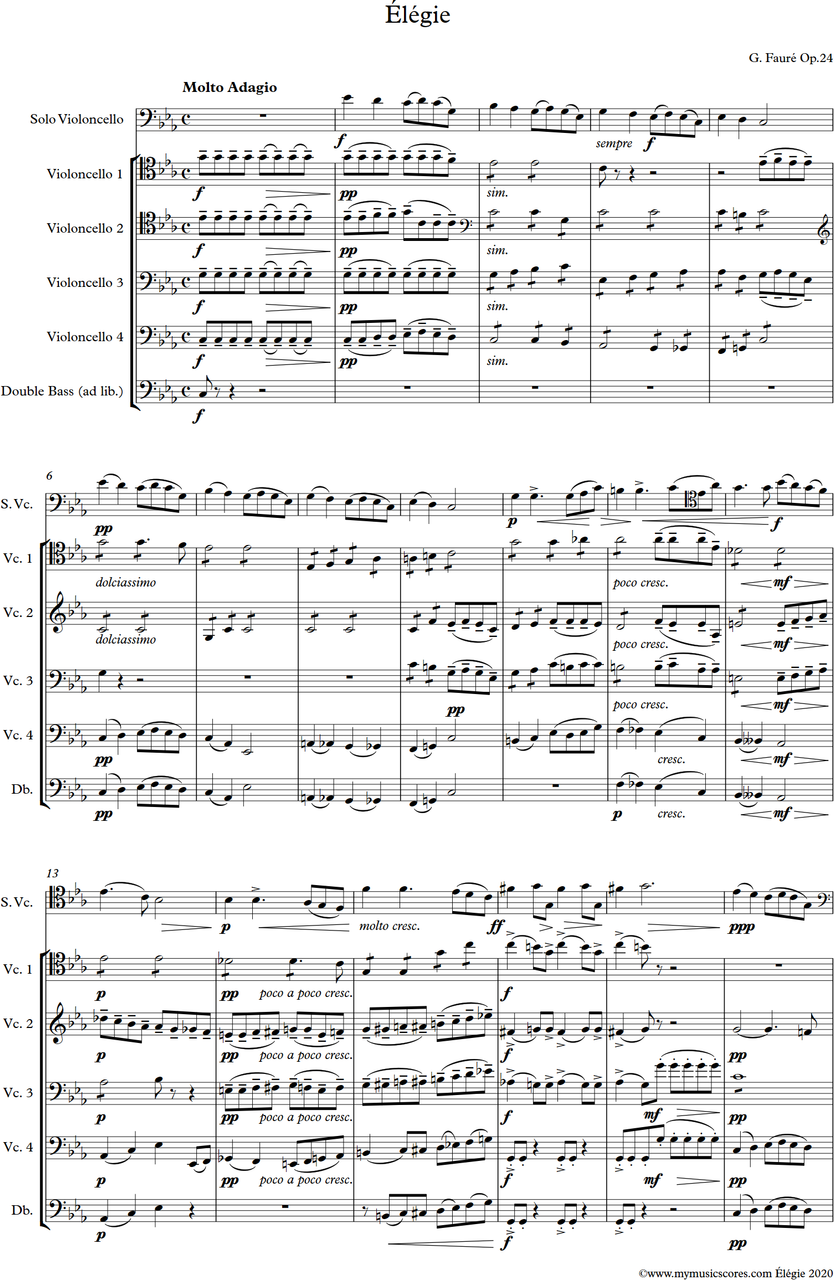
Check the score and parts preview images above, then watch the complete score video below. They'll give you a clear picture of the engraving quality and overall difficulty before you buy.
Key features
- Instrumentation: Solo Cello + Cello Quartet (Cello I, Cello II, Cello III, Cello IV)
- Original: Cello and piano (later orchestrated by Fauré for cello and full orchestra)
- Duration: approximately 6 minutes
- Style focus: sustained lyricism, chromatic intonation, wide dynamic range, structural contrast
- Format: PDF download, full score and all five cello parts
Who it's for
This suits cello masterclasses and workshops where a harmonically and emotionally demanding work is needed to stretch both the soloist and the ensemble; cello teachers with a capable group who are ready for something more complex than straightforward Romantic lyricism; and cello ensemble concerts where a substantial, deeply expressive centrepiece is needed.
Write a Review

Faure Elegy Op. 24 for Solo Cello and Cello Quartet
Videos Hide Videos Show Videos

Fauré: Élégie Op. 24 for Cello and String Orchestra Fauré's Élégie, Op. 24 is one of the most perfor…


Paradis: Sicilienne (Arr. Cello and Cello Quartet)

Saint-Saëns: Allegro Appassionato, Op. 43 (Arr. Cello and Cello Quartet) Saint-Saëns wrote the Alleg…
Gluck: Melody (Dance of the Blessed Spirits) from Orphée et Eurydice (Arr. Cello and Cello Quartet)…