
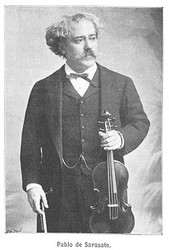
Closer to Home: Pablo de Sarasate's Spanish Character Pieces
Posted by Paul Wood on 19th May 2026
It's one of the minor ironies of Sarasate's career that two of his most famous works have almost nothing to do with Spain. Zigeunerweisen draws on Hungarian and Roma folk idioms. The Carmen Fantasy takes its material from a French opera set in Seville, about a fictional Spanish woman, written by a Frenchman for a French audience. Both are magnificent. But they are, in a sense, borrowed landscapes.
The Spanish character pieces are a different matter. These are the works where Sarasate is writing from the inside: the Andalusian singing style he would have heard as a child, the Basque folk music of the region bordering his native Navarra, the rhythms and ornaments of flamenco. They are shorter than the big showpieces, less obviously spectacular, and considerably more personal.
From his Op. 22 and Op. 23 sets of Spanish Dances, and the Op. 24 Caprice Basque, MyMusicScores publishes four of these character pieces across six editions.
Romanza Andaluza, Op. 22 No. 1
The Andalusian romance is one of the oldest forms in Spanish music: a slow, singing style with characteristic ornaments, a particular quality of melancholy, and a directness of expression that leaves nowhere to hide. Sarasate sets it with a simplicity that is harder to achieve than it looks. There are no technical fireworks here. The demands are all musical: a sustained singing tone, sensitive dynamics, the ability to shape a long melodic line with real conviction. It sits naturally in a recital programme as a moment of stillness between more energetic works, and it rewards audiences who are listening rather than watching.
Playera, Op. 23 No. 1
Playera is a form of deep flamenco, one of the older and more serious styles, closely related to what flamenco singers call the siguiriya. It is not a cheerful dance. It has a particular gravity, a quality of longing that settles in the instrument's middle register with unusual intensity. Sarasate's setting is full of the characteristic ornaments of the style: slides, expressive portamento, vibrato that narrows and widens with the phrase. It is one of his most idiomatic pieces, and one of the most rewarding to learn. MyMusicScores publishes it in two editions: for violin and string orchestra, and for solo violin and violin quartet.
Zapateado, Op. 23 No. 2
The Zapateado shares an opus number with the Playera but has almost nothing else in common with it. Where the Playera is slow and introspective, the Zapateado is fast, rhythmically ferocious, and unrelenting. The word comes from zapato, the Spanish for shoe, and refers to a style of Spanish tap dancing. The violin part takes the role of the dancer's feet: precise, percussive, required to maintain its rhythmic clarity at speed without ever sounding laboured. It is considerably harder to bring off than it might look, which is something tap dancers could probably say about the violin too.
Caprice Basque, Op. 24
If the Spanish Dances draw on Andalusian folk music, the Caprice Basque looks north, to the folk traditions of the Basque country, the region bordering Sarasate's native Navarra. It is the most technically demanding of the four pieces here, as the word caprice suggests: faster passagework, more varied bow techniques, a wider expressive range. It also has a distinctly different character from the Andalusian pieces: more angular, more rhythmically driven, less given to the long singing line of the south. Available from MyMusicScores in two editions: for solo violin and string orchestra, and for violin quartet.
The MyMusicScores arrangements
As with Part 1 of this series, all of these pieces exist in standard violin and piano editions and, in some cases, full orchestral versions. The MyMusicScores arrangements sit in the middle: professionally engraved editions for violin and string orchestra, or violin quartet where that edition is available, ready to perform and instantly downloadable.
For teachers, the character pieces sit at a generally more accessible level than Zigeunerweisen or the Carmen Fantasy, making them a strong choice for advancing students who are ready for recital work but not yet at the full concerto stage. For conductors, they're short enough to programme as a concert opener or as a complement to a larger work on the same bill.
All editions are available as instant PDF downloads with no performance licence required and permission to record included.
- Sarasate — Romanza Andaluza Op. 22 No. 1 for Violin and String Orchestra
- Sarasate — Playera Op. 23 No. 1 for Violin and String Orchestra
- Sarasate — Playera Op. 23 No. 1 for Solo Violin and Violin Quartet
- Sarasate — Zapateado Op. 23 No. 2 for Violin and String Orchestra
- Sarasate — Caprice Basque Op. 24 for Solo Violin and String Orchestra
- Sarasate — Caprice Basque Op. 24 for Violin Quartet
Browse the complete Sarasate collection at MyMusicScores.com