
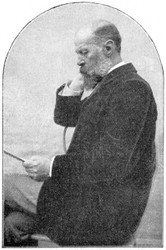
Carl Bohm and the lost art of the salon miniature
Posted by Paul Wood on 9th Oct 2026
In the cemetery at Wilmersdorf in Berlin there is a gravestone carved with a few bars of music. They are the opening of Still wie die Nacht, a song John McCormack, Ernestine Schumann-Heink and Emma Eames all recorded in the first decades of the twentieth century. The composer buried there is Carl Bohm. His brother Adolf, an architect and painter, designed the stone.
Hardly anyone programmes Bohm in a concert hall now. Violin teachers still meet him, though, because he wrote a great deal of music for exactly the players they teach, and a lot of it is very good.
Who was Carl Bohm?
Carl Bohm was a German pianist and composer, born in Berlin on 11 September 1844 and died there on 4 April 1920. He was the eldest of eight children. His father taught mathematics and later retrained as a surveyor, and the family moved away from Berlin, to Königsberg in der Neumark and then Arolsen. By 1868 Carl was back in the city, and he stayed for the rest of his life.
He made his name first as a pianist, then turned to composing: songs, piano pieces, operettas, piano trios and a very large body of short pieces for violin and piano. His opus numbers run past 390, and that count leaves out the collections he published without one. Two sets of first-position violin pieces, Da Capo (1894) and Prima Vista (1896), came out under a pseudonym, Henry Cooper.
He is easily confused with two other men: Karl Böhm the conductor, born in 1894, and Joseph Böhm, the Viennese violin teacher who taught Joachim. Carl Bohm published his music without the umlaut.
Percy Scholes summed him up in the 1943 Oxford Companion to Music as "a German composer of great fecundity and the highest salability". It was not meant entirely as praise. His main publisher was N. Simrock in Berlin, the house that published Brahms and Dvořák, and Bohm's violin music came out from the same house for years.
What the salon piece was for
The salon began as a room in a well-off house where guests gathered for conversation and music, and salon music was the repertoire written for it: short, self-contained pieces, usually for piano alone or piano and one other instrument, each built around one mood or idea. A nocturne, a mazurka, a romance, a spinning song.
By Bohm's lifetime the market for that music had moved well beyond the grand houses. Charles Rosen wrote that before 1900 "it was at home that music was most often experienced". The middle-class home often had a piano, and someone in the family usually played it, or sang, or had been having violin lessons for a few years. Publishers like Simrock fed that market, and Bohm was one of the composers who fed it best.
The critics never forgave the salon for being popular. Schumann was calling salon music superficial in 1841, and by the twentieth century "salon" had become shorthand for trivial. Some of it was. But the good salon piece did something hard: it gave a player who was not a professional three minutes of music that sounded finished in their hands.
Why I call it a lost art
Thomas Regelski, writing about amateur music-making, points out that the word amateur comes from the Latin for lover. His argument is that over the twentieth century music was steadily handed over to professionals, and the rest of us were turned into listeners. Rosen put the result plainly: few people make music at home any more.
The salon miniature belonged to the other world, the one where people played. Bohm wrote for the person at the music stand in the front room, not the person in the concert hall, and he took that person seriously. His violin writing mostly stays in first to third position, but within those limits he gives the player a real character to inhabit: a polonaise with snap in the bow, a Spanish serenade, a lullaby, a perpetual motion.
Look at what those pieces actually ask for and a pattern shows. The left hand usually stays in familiar territory. The bow arm does the work: dotted rhythms that need a quick, releasing stroke, accents and off-the-string playing in close succession, a slow middle section that needs a sustained singing tone. Regelski argues that the technique an amateur keeps is the technique learned from the music itself rather than from drills. A Bohm piece is a bowing lesson the player never notices as one.
I don't think the skill has disappeared, but I think fewer composers treat it as worth doing well. Writing a complete, characterful piece inside a Grade 5 technique is a narrower job than writing a concerto, and it is not easier. The salon has come back in other forms, too: house concerts, living-room gigs, small recitals in libraries and village halls. That kind of setting is exactly where Bohm's music was always meant to be played.
The MyMusicScores editions
Seven Bohm titles are in the catalogue. Four set his violin and piano originals for solo violin and string orchestra, so a soloist can perform with a school or community orchestra rather than a piano. The original solo line is kept in each.
Solo violin and string orchestra:
- Bohm - Sarabande for Violin and String Orchestra. From the Albumblätter, published by Simrock in 1891. Opening chords, crisp outer sections and a lyrical cantabile middle. About ABRSM Grade 6, 4 minutes.
- Bohm - Alla Polacca, Op. 257 No. 3, for Violin and String Orchestra. A polonaise with dotted rhythms that need real bite, and a warm E-string middle section. About ABRSM Grade 7, 3 minutes.
- Bohm - The Rain, Op. 187 No. 4, for Violin and String Orchestra. The Perpetuum mobile from the Sechs Miniaturen, first published in Dresden around 1878, and a regular in popular violin anthologies a century ago.
- Bohm - Perpetuo Mobile for Violin and String Orchestra. The finale of his Kleine Suite, published by Simrock in 1892.
Violin and piano:
- Bohm - Petite Rhapsodie Hongroise for Violin and Piano. Three contrasting sections: a big opening, a Tempo di Mazurka for short bow strokes and position changes, and an Allegro vivace to finish. About ABRSM Grade 5 to 6, 3 minutes.
Quartets:
- Bohm - Violin Quartet. A single movement in G major in sonata form, published by Simrock in 1901. All four parts sit at about ABRSM Grade 6, and the melody passes between them. About 6 minutes.
- Bohm - Viola Quartet. The same piece arranged for four violas, which warms the whole sound. About ABRSM Grade 6, 6 minutes.
All editions are professionally engraved, available as instant PDF downloads, with no performance licence required and permission to record included.