
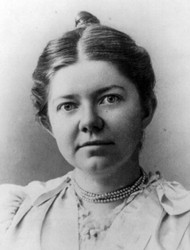
Amy Beach and the Romance, Op. 23: one piece, three soloists
Posted by Paul Wood on 26th Aug 2026
Chicago, the summer of 1893. The World's Columbian Exposition, in a hall built to show what women had made. Amy Beach was at the piano and Maud Powell had the violin, playing a Romance Beach had written for her and dedicated to her. Partway through, the music slid off the stand. Powell played on from memory to the end. Reports at the time say the audience refused to let them go until they had played it again.
It's a good story. It would be worth telling even if the piece were ordinary, and it isn't.
The terms
Beach married in 1885, at eighteen. Her husband, Dr Henry Harris Aubrey Beach, was a Boston surgeon twenty-four years older than her, and part of the arrangement was that she would give up the concert career she had already begun. She had made her debut with the Boston Symphony Orchestra. She was permitted a small number of public appearances a year after her marriage, with the proceeds going to charity, and was expected to compose instead.
I find it hard to read that without wincing. What matters for the music is what she did with it. She had exactly one year of formal training in harmony and counterpoint, with Junius Hill, and no composition teacher at all. When she asked Wilhelm Gericke of the Boston Symphony to recommend one, he told her to teach herself from the masters. So she did. She spent ten years working through fugue, double fugue and orchestration on her own, translating the standard treatises as she went, Berlioz's among them, because that was the only way to get at them.
The Gaelic Symphony came out of those ten years, premiered by the Boston Symphony in 1896, the first symphony by an American woman to be performed and published. Her Boston colleague George Chadwick wrote to her afterwards: "I always feel a thrill of pride myself whenever I hear a fine new work by any one of us, and as such you will have to be counted in, whether you will or not, one of the boys."
The Romance
The Romance, Op. 23 was written for violin and piano in 1893, three years before the symphony, and it already has everything the later music has.
The thing to notice is that it isn't a solo with accompaniment. It's a duo. The melody passes back and forward between the two players across three sections, and the piano part carries as much of the argument as the violin does. Beach was a concert pianist writing for one of the finest violinists of the day, and neither of them was going to sit and hold chords.
That matters more than it sounds, and it's the reason this piece has three MyMusicScores editions rather than one.
Because Beach wrote a genuine duo, the solo line is melody and nothing but. There are no double stops holding a texture together, no passagework that only makes sense across four strings tuned in fifths, no writing that depends on the violin being a violin. It's six minutes of long, exposed, singing line. The difficulty is musical rather than acrobatic, which is a different and in some ways harder thing: intonation with nowhere to hide, tone that has to carry over a sustained accompaniment, and dynamic shading across phrases that go on far longer than a student expects.
Why it moves
A line like that transfers. The viola edition keeps Beach's original key of A major, and the instrument's lower, darker sound suits music this unhurried. It gives violists something the repertoire is genuinely short of: a Romantic solo of real quality at concert length, written by someone who understood how to sustain a melody.
The cello version gets the same benefit. Cellists have plenty of Romantic showpieces and rather fewer six-minute lyrical solos that don't ask for the whole thumb-position arsenal. This one lets the instrument do what it does best.
In every case the string orchestra part is built from Beach's own piano writing. I've kept her harmony intact and rewritten the spacings and textures for strings, which is where a piano-to-strings arrangement either works or falls apart. The danger is turning a piano part into a wash of sustained chords, and here that would have been fatal, because half the piece's material lives in that part. Redistributed across the section, the writing gets its independence back. The soloist is supported throughout and never swamped.
The three editions
All three are the complete Romance, running to around six minutes, and all three sit at Grade 8. It's a piece for a player who can shape a long line, not one who simply has the notes.
There's a practical point here that's easy to miss. Three different soloists in the same ensemble can each take this piece with the same set of orchestral parts in front of them. If you have a strong violinist this year and a strong cellist next year, the Romance works both times.
- Beach, Romance Op. 23 for Violin and String Orchestra
- Beach, Romance Op. 23 for Viola and String Orchestra
- Beach, Romance Op. 23 for Cello and String Orchestra
All are professionally engraved, available as instant PDF downloads, with no performance licence required and permission to record included.